Free access / Consumer evidence
Permanent free tiers versus trading trials
Separate a published no-charge feature, a limited sample and expiring access before comparing trading resources.
The item, not the brand
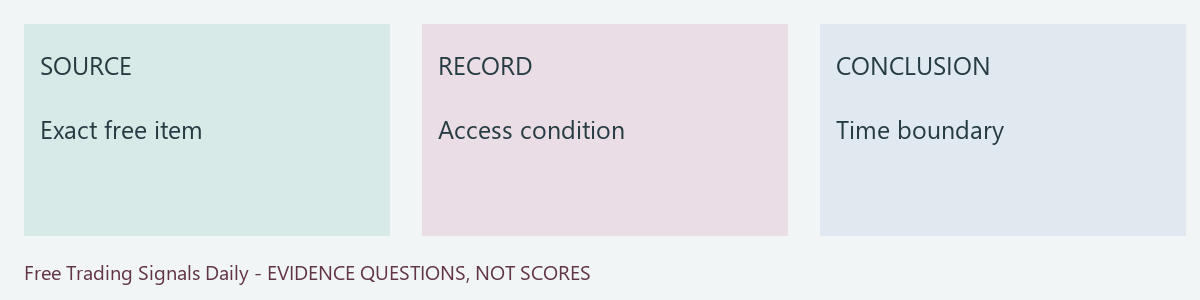
A useful free-offer record starts with an object: a particular public lesson, chart tier, downloadable file or message stream. A familiar brand can publish all four while selling a separate subscription. Naming the object prevents a free article from standing in for an entire paid account. Keep the specific page and access route with the observation, including whether registration was encountered. A headline saying free does not tell you which features were reachable. A narrower, verifiable description is valuable even when the wider catalogue has not been tested.
Duration is a separate dimension
Distinguish indefinite access as currently advertised from a contractual promise that terms can never change. A tier can be free today and subject to future feature changes. A trial has an explicit boundary; a sample can be a one-time object with no ongoing delivery at all. Preserve the seller's actual dates, duration language and renewal notice rather than inferring them from the label. If the end date is absent, mark it unknown. Do not choose an arbitrary observation period and then describe the product itself as a permanent free daily service.
Compare the same task
The right comparison depends on what the reader wants. Learning an order definition, researching revised economic data, monitoring a price condition and following authored instructions require different evidence. A public source may solve a learning task completely without publishing any trade calls. Conversely, a trial may expose a sophisticated interface but leave the post-expiry archive unavailable. Define the task before counting features. A free resource is not automatically a weak substitute for a subscription; it may be the correct object for a different question altogether.
A bounded access conclusion
Use three separate outcomes: available as observed, claimed but not tested, and unresolved. A visible official page establishes that documentation could be read; it does not prove successful account activation or continuous access. Keep the observation date separate from the last revision of the seller's terms. Record which feature or document needs rechecking before a purchase. There is no countdown monitor or automatic account tester on this publication. Its dated register is a manually prepared record, not a promise that every access route remains open throughout a future trading session.
Completed fictional consumer case
Fictional case: Mira needs to understand a limit order and later assess an alert workflow. She records an open educational article separately from a hypothetical ten-calendar-day software trial. The first item answers the definition question without a subscription. The second has unknown post-expiry export access, so she does not call it an ongoing free alert service. She has not traded or opened a paid account. Her final record preserves both useful learning and the unresolved trial boundary rather than collapsing them into a five-star provider verdict.
| Record | Evidence object | Bounded finding |
|---|---|---|
| Learning item | Public article | Definition answered; not a signal |
| Trial item | Invented ten-calendar-day window | Archive after expiry unknown |
| Decision | Two different tasks | No permanent feed inferred |
Primary references and their limits
Public documents reviewed 13 October 2026. A link supports its stated mechanism or access description, not a completed account trial or this desk's invented case.